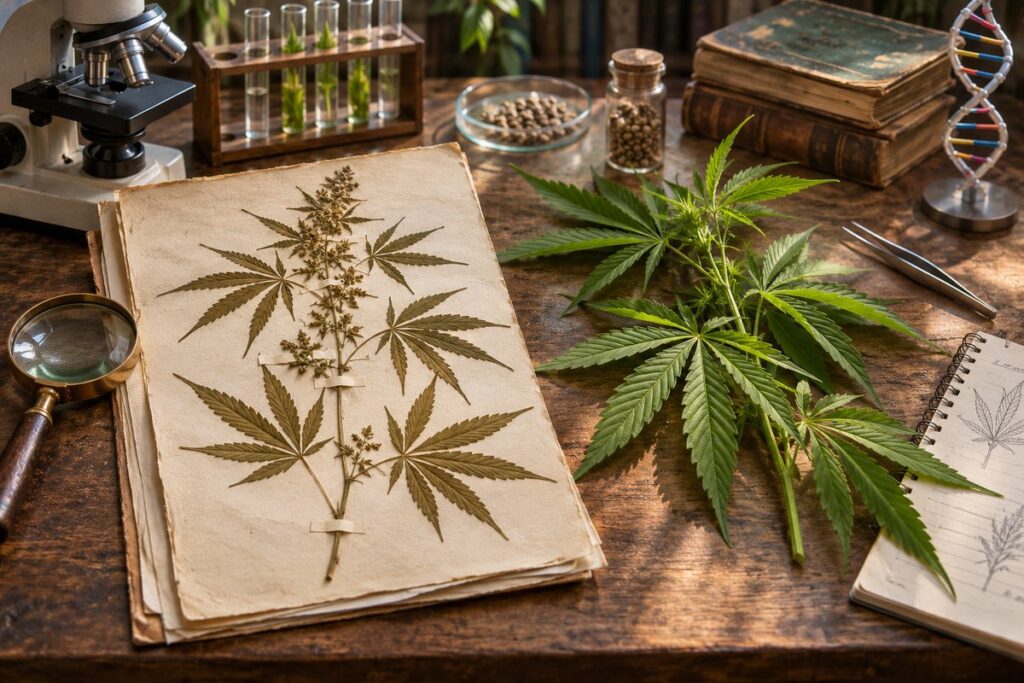
A cannabis plant growing beside a field in China can carry evidence of farming decisions made thousands of years ago. It can also be the descendant of a crop that escaped over the fence. To someone tracing the history of domestication, both possibilities matter. A plant growing without anyone tending it today acquires the label “feral” or “wild” rather easily. Working out what its ancestors were doing is a much harder assignment.
In 2021, Guangpeng Ren and colleagues compared whole genomes from 110 cannabis accessions of diverse origins. An accession is an identifiable sample in a collection, such as seed obtained from a particular population or variety. The set brought together plants cultivated for different purposes, traditional crop populations and plants growing outside cultivation. Rather than begin with a map of where the earliest farmers ought to have lived, the team asked which sampled plants shared the deepest genetic connections with today’s crops.
What it means to sit near the base of a family tree
Copies of DNA pass from parents to offspring with small differences. Some differences persist across many generations and turn up in several descendants. Looking across the genome, researchers can compare patterns of shared variation. A single stretch of DNA may have moved between crop populations through recent crossbreeding. Thousands of stretches provide a much fuller record, including evidence that branches reconnected. The team deposited the data files behind its population analyses so that others could examine the reconstruction.
One group in Ren’s analysis included Chinese feral plants and traditional local varieties, known as landraces. It represented the closest sampled counterpart to the ancestral gene pool from which modern hemp and drug cultivars arose. The authors interpreted the pattern as evidence for early domestication in East Asia. No living member of that group has been growing since the Neolithic. It occupies a position in a reconstruction because of the variants it shares with other groups, not because the plant itself is unusually old.
An earlier genetic survey by Jason Sawler and colleagues had already shown broad differentiation between hemp and marijuana in the samples it examined. Distinguishing two modern crop groups, however, does not locate their common beginning. To ask where a split occurred requires a wider sample, including populations that received little attention from modern commercial growers. A bag of seed from a village can change the interpretation of an entire branch.
Putting a date on a genetic split
Ren’s team estimated that ancestors of the later crop groups separated from the basal group roughly 12,000 years ago. The uncertainty interval extended from about 6,500 to 15,700 years ago. That spread belongs with the headline date. A demographic model converts genetic differences into time using assumptions about how populations changed and how quickly generations accumulated differences. It does not date a particular planting season or tell us when someone first chose to save seed.
A physical find starts at the other end of the problem. Research on ancient cannabis seeds from Haimenkou in Yunnan examines measurable traits of actual remains and compares them with modern material. Such evidence can put cannabis at a particular site within an archaeological context. It has other limitations: a few surviving seeds may say little about the range of plants nearby, and finding a seed does not by itself reveal why it was collected.
The missing plants on the map
A genomic study can only place the branches for which some descendants have survived and entered the sample. Populations may have disappeared. Farmers carried seed far from its origin. A roadside stand might reflect quite recent introductions, even in a region with an ancient history of cultivation. Those possibilities matter especially when the research question begins with the word “where.”
The strength of the East Asian reconstruction lies in how well it accounts for the sampled genomes and how it can be tested. Additional landraces, securely dated remains or recoverable ancient DNA could bring an overlooked branch into view. The living plant by the field offers a long record of inheritance. Pinning that record to a place and a moment takes more than a coordinate written on a seed packet.