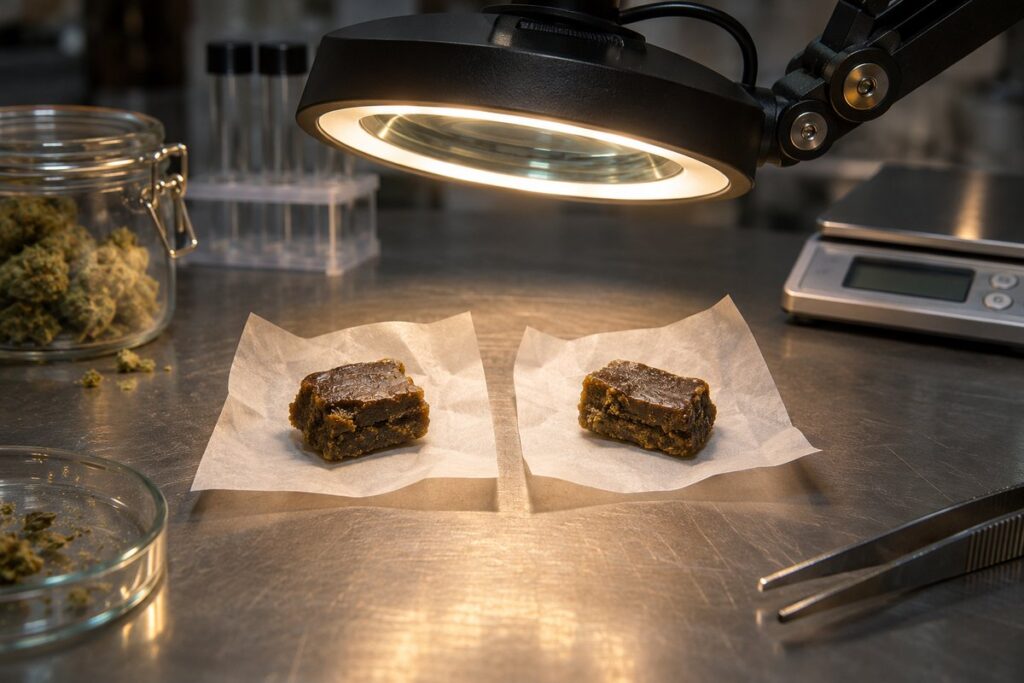
Two envelopes of cannabis resin arrive at a laboratory. Each contains measurable amounts of THC, CBD and CBN. The chemist can identify those compounds and put numbers beside their names. Now comes a question the instrument cannot answer directly: did the two samples spend the same number of years in storage? Even a perfect match between the three readings would leave room for different histories.
There is enough regularity in the chemistry to make the question worth asking. THC can degrade during storage, and CBN can form as part of that change. In a collection of samples with documented storage periods, particular combinations of measurements may tend to turn up earlier or later. That relationship is the basis of a chemical age estimate. It also explains why the collection used to establish the relationship matters so much.
Working backward from three measurements
Nezha Fettoukh and colleagues had an unusual reference collection: 150 specimens of seized cannabis resin from Morocco, some held in storage for as long as eight years. They measured cannabinoid composition and investigated several ways to describe its relationship with storage time. One part of the analysis ran forward, asking how composition varied with the documented interval. Another ran backward, asking whether the measured composition could predict the interval.
The two exercises sound interchangeable until one imagines mailing the lab a sample with its label missing. There may be several combinations of starting composition and storage history consistent with the measurements. The model must nevertheless produce an estimate. Its answer reflects which combinations were common among its reference samples. Two specimens given the same estimated age might simply occupy much the same neighborhood in that particular collection.
The researchers evaluated predictions on portions of their dataset held aside from model fitting. That gives a fairer assessment than asking how well an equation reproduces only the measurements used to build it. The held-back samples still came from the same wider collection, however. Predicting a specimen from a different region, with an unfamiliar history before seizure, is a further test. Its measured chemistry may be perfectly sound while the assumptions connecting that chemistry to a date are a poor fit.
An experiment with several storage histories
A four-year study by Luca Zamengo and colleagues addressed a closely related problem by following cannabis materials under different storage conditions. The researchers observed declining THC and increasing CBN in material kept at room temperature, with less pronounced changes under refrigeration. Light exposure also influenced the relationship between THC loss and CBN formation. The chemical record depended on what happened during the interval as well as on its length. Earlier storage experiments with plant material, resin and solutions had also found that exposure to light could change how preparations aged.
Consider an older specimen that changed relatively slowly and a more recent specimen that changed rapidly. Their paths through a graph of THC against CBN could approach each other. This is a thought experiment, not a claim that a specific pair in either study was misdated. It illustrates why another decimal place on the laboratory report cannot necessarily resolve an unknown storage history. Precision in a concentration and certainty about a date are different achievements.
What date was recorded in the first place?
The start of a documented storage interval could be the date a sample entered custody. The cannabis plant had already been harvested and its resin collected. A prediction calibrated against time in custody will speak most directly to that interval. Extending it back to harvest would require information about what happened before the envelope reached the archive. The distinction can be easy to miss when a table has room for only one column headed “age.”
Earlier work on CBN-to-THC ratios in stored plant material made its room-temperature conditions explicit. That qualifier is still useful. Given a comparable reference collection and documented conditions, chemistry can help narrow a plausible interval. Faced with two unlabelled envelopes, a chemist might reasonably say their profiles resemble samples stored for similar periods in one study. That careful sentence tells us something real without quietly supplying a history neither envelope came with.