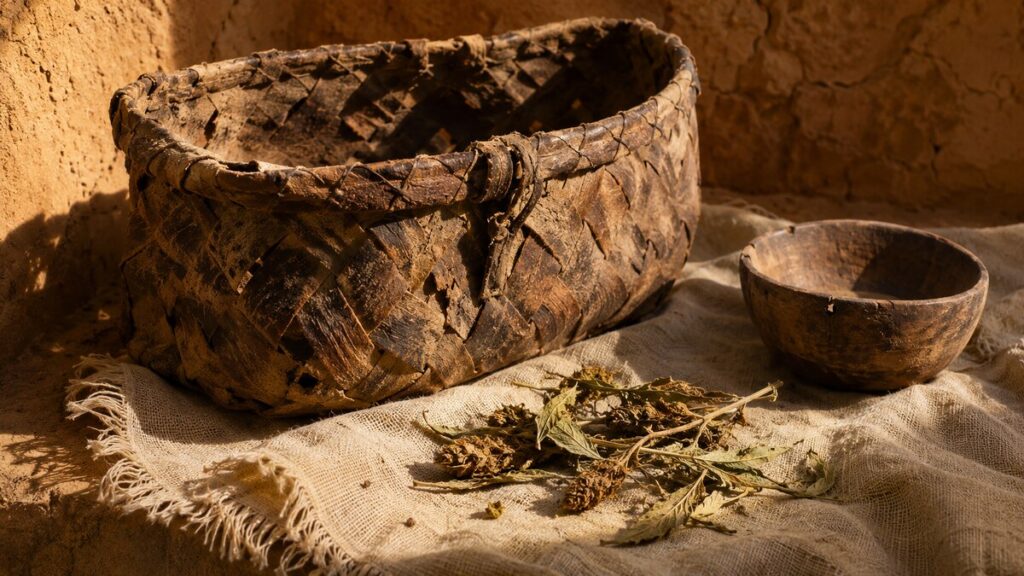
The plant material looked enough like coriander to earn an early identification as a kitchen herb. It had survived near Turpan in western China for roughly 2,700 years. A closer botanical examination changed the name to Cannabis sativa. That correction turned a basket and a bowl from the Yanghai cemetery into an unusually rich experiment. How much could scientists learn about an ancient plant when they had far more to go on than a seed or a stain?
A find large enough to ask several questions
The containers held about 789 grams of plant material. That number describes what the archaeologists recovered, after centuries underground. It does not tell us what somebody originally weighed out. Still, the sheer quantity matters. A minute scrap must sometimes be used up to answer a single question. With material from Yanghai, botanists could inspect physical structures while colleagues examined the chemistry and looked for surviving genetic information.
The investigation published in the Journal of Experimental Botany drew these lines of evidence together. The desert setting and burial conditions had preserved enough recognizable tissue to make botanical identification possible. Preservation, however, is uneven. A leaf can retain a recognizable outline after the compounds inside it have changed. A sample that looks surprisingly fresh in a photograph need not have the chemistry of a freshly picked plant.
The question a molecule can answer
The team reported THC and cannabinol, one of the substances that can form as THC degrades. The surviving compounds provided evidence about what the plant could once produce. They were a much poorer basis for estimating the concentration when somebody put it in the grave. Modern research following cannabis samples through storage can start with a known measurement and take another later. Archaeologists rarely enjoy the first half of that experiment.
Genetic evidence offered a different angle. The researchers recovered sequence information associated with the plant’s capacity to make a THC precursor. Having a piece of that genetic machinery and detecting chemical products are mutually informative observations. Neither tells us precisely what a particular flower would have contained in the season when it was gathered. Nor can a sequence recovered from the plant identify the person who grew or selected it.
A plant in a grave has more than one possible history
Someone took the trouble to put this material into containers and leave it among the burial goods. The research team discussed a possible medicinal or ritual purpose. Those possibilities are interpretations of the assemblage. At a different cemetery in the Turpan Basin, cannabis plants were laid across a body. Arrangement added a clue that an inventory of species alone would have missed. An instrument can help identify a molecule in a sample taken from the bowl. It cannot distinguish a remedy from a ceremonial offering if either purpose would have left the same molecule behind.
Consider how different the question would be if the object had been charred on the inside. At Jirzankal Cemetery in the Pamirs, residues were associated with burned wooden vessels and heated stones. That combination gave investigators a physical link to an action. The Yanghai containers preserve something the braziers largely lost: the plant itself. Each find answers a question the other leaves tantalizingly open.
What survives the change of name
Calling the material coriander would have sent almost every subsequent question in a different direction. The botanical correction is a reminder of how much depends on the first, seemingly modest job of getting an identification right. Once the contents were recognized, chemists could choose appropriate reference compounds, and geneticists could ask whether particular pieces of DNA had survived.
Even the best-preserved burial cannot give a complete account of an everyday practice. The evidence at Yanghai is remarkable for a more tangible reason. Someone handled a living plant, someone placed a portion of it near the dead, and a dry burial environment kept enough of that choice intact for several disciplines to examine it independently. Their answers agree most closely on the matter that initially fooled the eye: what was in the bowl.