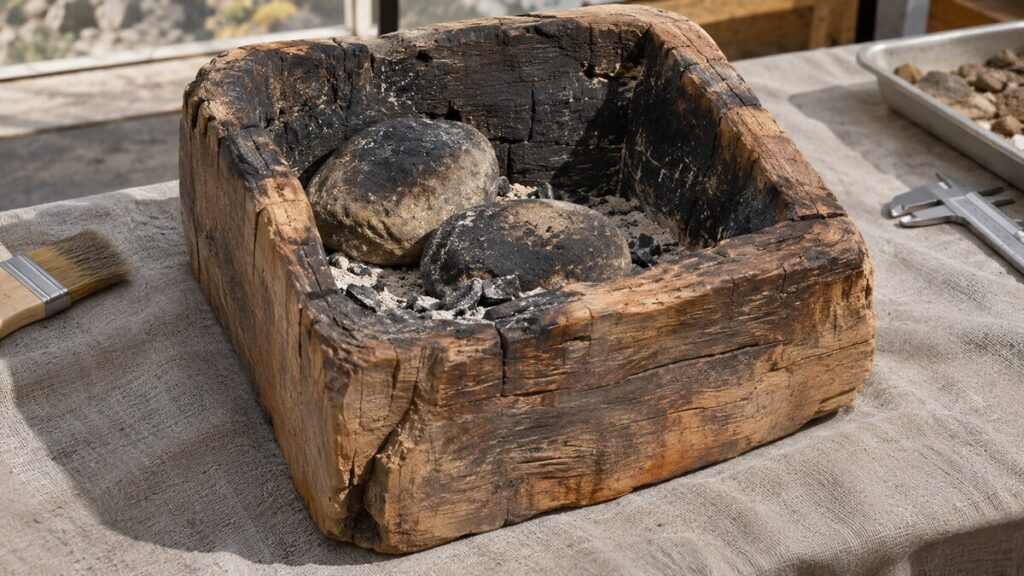
On one side of a wooden vessel from the eastern Pamirs, archaeologists found a chemical trace of cannabis. On the other side they found none. It is tempting to skip that second result. Yet the clean outside of the vessel helps explain why a team of researchers thought the trace inside had something to do with a funeral held roughly 2,500 years ago.
Reading the inside of a bowl
The vessels came from Jirzankal Cemetery, high in the mountains of what is now western China. Their interiors showed signs of burning, and some contained stones exposed to heat. The arrangement suggested braziers, containers in which something could be heated or burned. Anyone looking at them could see the charring. Deciding what had burned required evidence of a different kind.
In their report in Science Advances, the researchers describe sampling the charred interiors, the stones and the outside of the wood. They used an instrument that separates a mixture into components and then breaks molecules into charged fragments. The pattern of those fragments helps identify a substance. It is much the same intellectual problem as recognizing a melody when only a few bars have survived. An apparent match means more when several features agree.
Why sample the outside?
Imagine that the laboratory had found the same trace on every surface it tested. Cannabis might still have been burned in the vessels. But contamination in the burial environment or during later handling would also deserve attention. Finding a signal chiefly where burning took place brings the chemical result into line with the physical evidence. An exterior sample is a modest control with considerable explanatory power.
The team detected cannabinol, or CBN, in burnt material from all but one of the sampled wooden interiors and on two stones. The exterior samples contained no detectable cannabinoids. CBN can form as THC changes over time. It gives investigators a way to recognize a substance whose original composition has altered substantially. A modern analysis of changes in stored cannabis over four years shows why working backward from a measurement made today is more complicated than reading an ancient label.
A funeral is a setting, not a transcript
Taken together, the burial setting, the heat-darkened wood and the chemical results support the interpretation that people burned cannabis during mortuary ceremonies. The instruments cannot say who placed it there, who stood nearby or what any of them expected to experience. We can reconstruct an action more securely than an intention. That distinction is easy to lose in a picture of mourners gathered around a smoking vessel, however carefully the artist has drawn the bowl.
Other discoveries supply a useful comparison. At the Judahite shrine of Arad, researchers identified cannabis residues on one altar and frankincense on another. The difference between two neighboring objects mattered there, just as the difference between surfaces mattered in the Pamirs. At Yanghai, another ancient cemetery in western China, researchers had actual plant material to examine. Leaves, seeds and chemistry could help establish what had been buried. They offered much less direct evidence of how it had been consumed. Jirzankal presents almost the reverse situation. Little recognizable plant material was needed to connect cannabis residues to the charred surfaces of equipment used for heating.
What it means to call evidence early
An early dated find gives archaeologists a point by which a practice existed in one place. It takes an additional leap to call that place its birthplace. The difference has as much to do with preservation as with human ingenuity. A wooden bowl must survive burial, attract an excavator’s notice and retain enough residue for an instrument available centuries later. Other people may have done similar things with equipment that left no comparable record.
The most convincing sentence about Jirzankal is therefore quite local. In a cemetery in the eastern Pamirs, vessels used around the middle of the first millennium BCE preserve evidence that people burned cannabis. It is a claim narrow enough to check against the objects. For that very reason, it tells us rather more than a sweeping story about the first person ever to inhale cannabis smoke.